
How to Stop Seizures in Dogs Immediately? (Vet Verified)

Watching your dog have a seizure is one of the most frightening experiences a pet owner can face. Your instinct is to do something – but knowing what to do (and what not to do) can make all the difference. So if you’re wondering “how to stop seizures in dogs immediately”, let’s dive into the question.
How to Stop Seizures in Dogs Immediately – The Short Answer
You cannot safely stop an active seizure in a dog at home. There is no immediate at-home method proven to halt a seizure once it has begun. The most effective response is to keep your dog safe, time the episode, remove hazards from the area, and contact your veterinarian immediately — especially if the seizure lasts longer than 5 minutes or if multiple seizures occur in a 24-hour period.
Key Takeaways
- There is no safe, proven at-home method to stop a dog seizure immediately
- Most seizures last 1–3 minutes and end on their own
- Your job during a seizure is to keep your dog safe, not to intervene physically
- Seizures lasting more than 5 minutes are a veterinary emergency
- Cluster seizures (two or more within 24 hours) require urgent veterinary attention
- Long-term monitoring of activity, rest, and heart rate trends can help your vet manage your dog’s condition
Can You Stop a Seizure in a Dog Immediately?

The honest answer is no — and understanding why matters.
During a seizure, your dog’s brain is experiencing abnormal electrical activity that cannot be interrupted by touch, sound, or home remedies. As VCA Animal Hospitals explains, attempting to put your fingers or an object into your dog’s mouth will not help and puts you at serious risk of being badly bitten. Attempting to restrain your dog or administer substances without veterinary guidance can cause injury to both of you.
“The most important thing during a seizure is keeping the dog safe and monitoring the duration of the episode. Careful observation of behavior, activity, and recovery patterns can also provide valuable information for veterinarians managing seizure disorders.” — Carolina Domingues, DVM, Veterinarian at Maven Pet
What you can do is respond calmly, protect your dog from harm, and gather the information your vet will need.
What Should You Do During a Dog Seizure?
Stay calm. Your dog cannot hear or respond to you normally during a seizure, but your presence and calm behavior can help once it passes. The AVMA recommends keeping your pet as warm and quiet as possible after the seizure has stopped, and contacting your veterinarian or local emergency hospital promptly.
Do:
- Start a timer as soon as the seizure begins
- Clear the area of hard furniture, stairs, or other hazards
- Gently cushion your dog’s head with a folded blanket or towel if possible
- Keep other pets and children away
- Speak in a low, calm voice
- Record the seizure on your phone if it is safe to do so — the footage can be invaluable for your vet
Do not:
- Put your hands near your dog’s mouth — dogs cannot swallow their tongue, and you risk a serious bite
- Restrain your dog’s limbs or body
- Pour water on your dog or put anything in their mouth
- Leave your dog unattended near stairs or water
“I got the Maven sensor for my 14-year-old Chihuahua mix with heart and trachea issues. It gave me back peace of mind – I can track her RRR, BPM, drinking, and activity anytime and know instantly if something’s wrong. Highly recommend!”

★★★★★
Chiara De Luca
Titti
Dog Seizure First Aid: Step-by-Step
- Stay calm and start timing. Note when the seizure begins.
- Create a safe space. Move objects away from your dog to prevent injury during convulsions.
- Cushion the head. Place a soft item under your dog’s head if they are on a hard surface.
- Do not restrain. Allow the seizure to run its course without physically intervening.
- Speak gently. A calm voice can be comforting during the postictal (recovery) phase that follows.
- Monitor and record. Observe duration, body movements, and symptoms. Video if possible.
- Call your vet. Always contact your veterinarian after a seizure, even if your dog appears to recover quickly.
- Go to an emergency clinic if the seizure exceeds 5 minutes. This is a medical emergency.
What Causes Seizures in Dogs?
Seizures can result from a wide range of underlying conditions. According to Texas A&M Veterinary Medical Teaching Hospital, veterinarians generally divide causes into those arising from physical problems within the brain, metabolic issues outside the brain, and idiopathic (unknown) causes. Common causes include:
- Idiopathic epilepsy — the most common cause in dogs aged 1–5 years; believed to have a genetic component (Cornell University College of Veterinary Medicine)
- Brain tumors or structural lesions
- Toxin exposure — certain plants, medications, xylitol, and household chemicals (Texas A&M VMBS)
- Metabolic disorders — including low blood sugar (hypoglycemia), liver disease, or kidney failure
- Infectious diseases — such as distemper or encephalitis
- Head trauma
Because the causes vary widely, a thorough veterinary workup — including bloodwork, urinalysis, and potentially MRI or cerebrospinal fluid analysis — is essential for a first-time seizure or a change in seizure pattern.
What Are Cluster Seizures in Dogs?
Cluster seizures refer to two or more seizures occurring within a 24-hour period. According to Texas A&M Veterinary Medical Teaching Hospital, cluster seizures are particularly concerning because they can lead to increased body temperature and dangerous metabolic changes. They are considered more serious than isolated episodes because:
- The brain has less time to recover between episodes
- They carry a higher risk of status epilepticus (a prolonged, life-threatening seizure)
- They may indicate worsening of an underlying neurological condition (Cornell University College of Veterinary Medicine)
Dogs experiencing cluster seizures require emergency veterinary care. If your dog has a second seizure within 24 hours, do not wait — contact your vet or an emergency animal hospital immediately.
When Is a Dog Seizure an Emergency?
Seek emergency veterinary care immediately if:
- The seizure lasts more than 5 minutes (status epilepticus) — VCA Animal Hospitals notes that without intravenous anticonvulsants, a dog in this state may suffer irreversible brain damage
- Your dog has more than two seizures in 24 hours (cluster seizures)
- Your dog does not regain consciousness between seizures
- Your dog has difficulty breathing during or after the episode
- Your dog is very young, very old, or has a known underlying illness
- It is your dog’s first seizure
Even for seizures that resolve quickly, always follow up with your veterinarian. A first seizure always warrants a full medical evaluation.
Are There Natural Ways to Stop Seizures in Dogs Immediately?
There is currently no scientifically validated natural remedy proven to stop an active seizure in a dog. Some owners ask about honey (for suspected hypoglycemia in toy breeds or diabetic dogs), CBD oil, or acupuncture — but none of these should be used during an active episode, and none should replace veterinary treatment.
If your dog has been diagnosed with epilepsy, your vet may discuss complementary strategies as part of a broader management plan. However, any supplement or alternative treatment should be discussed with your veterinarian before use — some substances can interact with anti-seizure medications or worsen underlying conditions.
Long-term seizure management is most effective when it combines appropriate medication, dietary support if recommended, and consistent monitoring of your dog’s health trends over time.
How Maven Helps
While the Maven Pet Health Monitor cannot diagnose or stop seizures, it gives owners and veterinarians objective, continuous data that can support long-term seizure management.

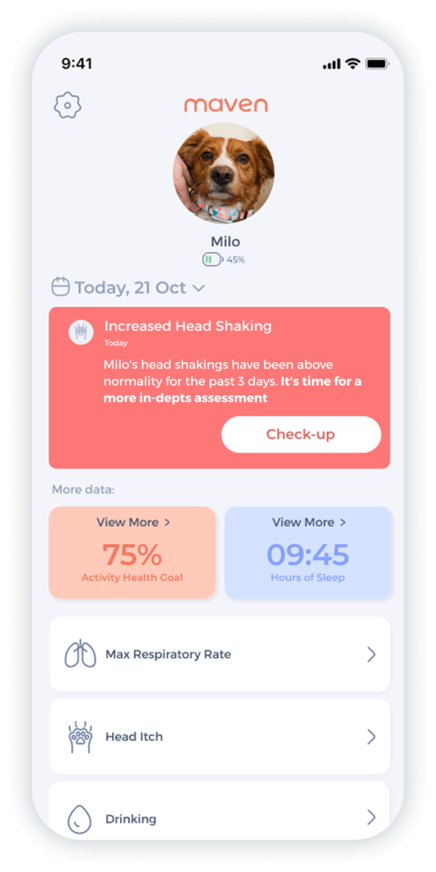
Monitor heart rate, respiratory rate, activity & rest, drinking, itch behavior.
Maven’s pet health app helps by:
- Episode tracking via the Journal feature, so you can log seizure events with dates, duration, and observations
- Continuous activity monitoring with Maven’s dog activity tracker, helping identify unusual behavioral changes before or after seizure events
- Rest pattern tracking, which can be disrupted in dogs with neurological conditions
- Heart rate trend monitoring, providing additional context about your dog’s overall health status
- Resting respiratory rate tracking via Maven’s dog respiratory rate tracker, supporting long-term wellness monitoring
- Water intake monitoring (dogs only), which may change with certain health conditions or medications
- Personalized baseline building, so the app learns what is normal for your dog specifically
- Deviation alerts, notifying you when significant changes occur that may warrant veterinary attention
By collecting objective data between episodes, Maven’s dog health tracker helps owners bring meaningful, actionable information to veterinary appointments — rather than relying on memory alone.
FAQ (Vet-Reviewed)
There is no safe at-home method to stop an active seizure. Keep your dog away from hazards, time the episode, and contact your veterinarian. If the seizure lasts more than 5 minutes, seek emergency care right away.
Stay calm, start a timer, clear the area of hard objects, cushion your dog’s head, and do not put your hands near their mouth. Speak gently and call your vet once the seizure ends. The AVMA recommends contacting your veterinarian or local emergency hospital immediately after any seizure event.
Common causes include idiopathic epilepsy, brain tumors, toxin exposure, metabolic disorders such as low blood sugar or liver disease, infections, and head trauma. A veterinary workup is necessary to identify the underlying cause. See VCA Animal Hospitals for a detailed overview of diagnosis and testing.
Cluster seizures are two or more seizures within a 24-hour period. They are more serious than isolated seizures and require emergency veterinary care, as they increase the risk of status epilepticus. Texas A&M Veterinary Medical Teaching Hospital describes cluster seizures as a serious neurological emergency requiring rapid diagnosis and treatment.
No natural remedy has been proven to stop an active seizure in a dog. Any complementary approaches — such as CBD oil or dietary changes — should only be discussed with your veterinarian as part of a broader management plan, never as a substitute for emergency care.
Conclusion
When your dog has a seizure, the most powerful thing you can do is stay calm, keep them safe, and track what you observe. There is no safe way to stop a seizure in progress at home — but there is a great deal you can do to support your dog’s long-term health.
Work closely with your veterinarian to understand the cause, establish a management plan, and monitor trends over time. Tools like the Maven pet health tracker can help you build the objective data picture your vet needs to provide the best possible care.
Maven Pet focuses on improving the quality of life of our pets with technology, using artificial intelligence (AI) to enable proactive pet care. By accurately collecting and monitoring pet data 24/7 and flagging any irregularities, Maven Pet empowers pet parents and veterinarians to stay ahead of potential health issues, ensuring the well-being and longevity of our beloved companions.